
For many small and mid-sized businesses (SMBs), cybersecurity budgeting feels like a lose-lose proposition. Spend too little, and a single ransomware attack or data breach could cripple operations. Spend too much, and cybersecurity becomes a cost center that leadership struggles to justify, especially when growth, hiring, and customer acquisition are competing for the same dollars.
This tension is not a failure of awareness. Today’s SMB leaders understand cyber risk better than ever. It’s a failure of framing. Too often, cybersecurity budgets are built around tools, fear-driven purchases, or compliance checklists rather than around business risk, return on investment (ROI), and long-term sustainability.
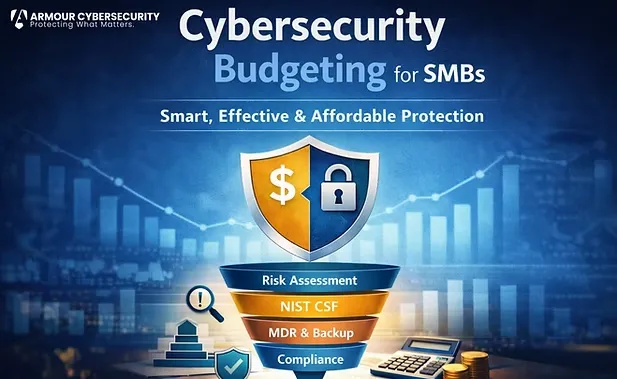
The reality is this: effective cybersecurity for SMBs is not about spending more, it’s about spending intelligently. With a clear prioritization roadmap, an understanding of total cost of ownership (TCO) in cybersecurity, and alignment to proven frameworks like the NIST Cybersecurity Framework (CSF), SMBs can dramatically reduce risk without breaking the bank.
Why Cybersecurity Budgets Break Down at the SMB Level
Most SMB cybersecurity budgets fail quietly long before an incident occurs. They fail when leadership invests in overlapping tools that no one monitors. They fail when compliance requirements drive spending that looks good on paper but doesn’t stop real attacks. And they fail when businesses underestimate the operational cost of “managing security internally.”
In Canada, the U.S., and across LATAM, we see the same pattern repeated: SMBs buy technology hoping it will substitute for strategy. But cybersecurity doesn’t work that way. Tools without context create noise, not protection.
A resilient cybersecurity budget starts with a simple but powerful shift in mindset: cybersecurity is risk management, not IT shopping.
The Regional Reality of SMB Cybersecurity Spending
While the threats are global, SMB cyber budgets are shaped by local realities.
In Canada, SMB cyber costs are often influenced by privacy and data protection regulations such as PIPEDA, as well as growing pressure from enterprise customers demanding stronger security postures. Limited access to senior security talent has also pushed many Canadian SMBs toward managed and virtual security models.
In the United States, SMB security spend is generally higher, driven by aggressive ransomware activity, cyber insurance requirements, and increasing board-level oversight. For many U.S. SMBs, cybersecurity has become a governance issue, not just a technical one.
Across LATAM, SMB security budgets tend to be leaner, but investment is accelerating, particularly in backup and disaster recovery (DR), as ransomware groups increasingly target organizations perceived as under-defended.
Despite these regional differences, one truth holds everywhere: SMBs that focus on risk reduction per dollar spent consistently outperform those that chase the latest security tools.
Using NIST CSF Tiers to Anchor Your Budget
The NIST Cybersecurity Framework offers an effective way to anchor cybersecurity spending to maturity and business needs rather than fear.
Most SMBs do not need to operate at the most advanced tier. In fact, overspending on “Tier 4” capabilities often introduces complexity that increases risk rather than reducing it. Instead, the sweet spot for most organizations lies between Tier 2 (Risk Informed) and Tier 3 (Repeatable).
At these tiers, cybersecurity budgets focus on consistency, visibility, and response—ensuring that threats are detected early and contained quickly. This approach delivers measurable ROI while keeping costs predictable and defensible at the board level.
Where SMB Cybersecurity Budgets Actually Deliver Value
A cost-effective cybersecurity budget isn’t built around dozens of line items. It’s built around a few foundational investments that deliver outsized impact.
Identity and access security is one of the clearest examples. Controls like multi-factor authentication (MFA) and privileged access management are inexpensive relative to their ability to reduce credential-based attacks, the most common breach vector facing SMBs today. This is low-cost security with high-risk reduction.
Endpoint and email protection follow closely behind. While these controls are widely adopted, their effectiveness depends entirely on visibility and response. An alert no one sees is no protection at all. This is where many SMBs underestimate true costs, believing licenses alone are sufficient.
MDR: The Turning Point for SMB Security Economics
Managed Detection and Response (MDR) is often perceived as a “luxury” reserved for large enterprises. In practice, MDR is one of the most cost-effective security investments an SMB can make.
When evaluating MDR cost, it’s critical to compare it not to a tool license, but to the alternative: attempting to monitor, investigate, and respond to threats internally. Even a single full-time security analyst costs more annually than most MDR services, without providing 24/7 coverage.
MDR shifts cybersecurity from a reactive expense to a predictable operating cost, delivering continuous monitoring, threat containment, and incident response. For SMBs facing board scrutiny, insurance requirements, or customer audits, MDR often becomes the backbone of a defensible security posture.
Backup and Disaster Recovery: Spending Where It Counts
Backup and disaster recovery costs are often minimized until it’s too late. Yet in today’s threat landscape, backups are not optional, they are existential.
Ransomware attacks no longer focus solely on encryption. They target backups, recovery processes, and operational dependencies. SMBs that invest only in backup storage but neglect recovery testing or immutability controls often discover the gap during an incident.
Viewed through a business lens, backup and DR investments protect revenue continuity, customer trust, and operational survival. This is not IT insurance, it is business resilience.
Compliance Budgets That Strengthen, Not Drain, Security
Compliance is frequently seen as a necessary evil, an unavoidable cost with little security benefit. But when approached strategically, a compliance budget can amplify security rather than dilute it.
Frameworks such as SOC 2, ISO 27001, and industry-specific regulations can serve as force multipliers, aligning controls, documentation, and operational discipline. The key is leadership and prioritization, something most SMBs lack internally.
This is where virtual CISO (vCISO) services become transformational.
vCISO: Executive Security Without Executive Cost
Full-time CISOs are out of reach for most SMBs, but the absence of security leadership often results in fragmented spending and unclear priorities. A vCISO bridges this gap by providing strategic oversight, board-level communication, and budget rationalization at a fraction of the cost.
Effective vCISO pricing delivers value not by adding tools, but by eliminating waste, aligning investments to risk, and translating cybersecurity into language boards and executives understand.
For SMBs preparing for growth, audits, or investment, vCISO support often becomes the difference between reactive spending and confident decision-making.
Turning Cybersecurity Into a Board-Ready Investment
Boards don’t approve cybersecurity budgets because of fear—they approve them because of clarity. A strong board cyber budget narrative clearly explains what risks are being reduced, how investments protect the business, and what outcomes leadership can expect over time.
By grounding decisions in risk reduction, NIST CSF alignment, and realistic TCO calculations, cybersecurity becomes a strategic investment rather than an open-ended expense.
How Armour Cybersecurity Helps SMBs Spend Smarter
At Armour Cybersecurity, we help SMBs across Canada, the U.S., and LATAM build cybersecurity programs that are right-sized, risk-driven, and financially defensible.
We work with leadership teams to design cybersecurity budgets that:
- Align with business priorities and NIST CSF maturity tiers
- Optimize MDR, backup, and DR costs for maximum impact
- Leverage vCISO leadership for governance and board confidence
- Reduce compliance burden while improving real-world security
- Demonstrate clear ROI and measurable risk reduction
Build Your Cyber Budget Blueprint With Confidence
Cyber threats will continue to evolve, but uncontrolled spending doesn’t have to be the answer.
Armour Cybersecurity helps SMBs protect what matters most while staying financially disciplined.
Contact Armour Cybersecurity today to build a smarter, stronger cybersecurity budget, one that protects your business without breaking the bank.